
A strong prompt does not simply say “make a quiz.” It defines the learner, objective, source, evidence, format, difficulty, feedback, and boundaries. Replace the brackets, attach trusted material, and review every output.
Begin with the evidence you need
State the age, language, prior knowledge, exact objective, question count, and available time. Describe what a correct response must demonstrate, and tell the model to flag missing information rather than invent it.
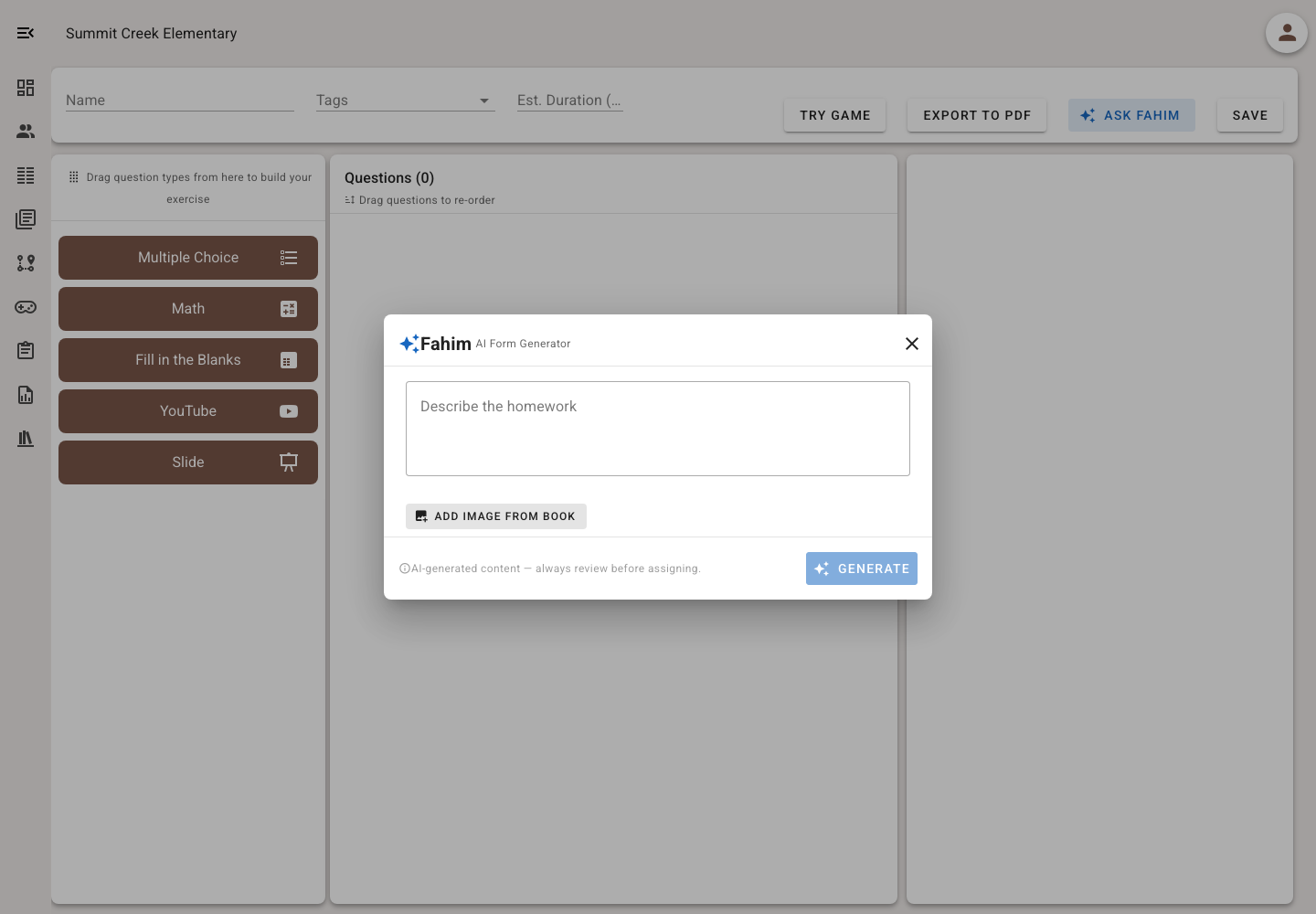
Prompts for retrieval and understanding
Use these after teaching or reading, with the trusted source attached.
- Create [number] short retrieval questions from [source] for [age], covering only [objective].
- Write literal and inferential questions; cite the passage supporting each answer.
- Turn these terms into matching items with distractors based on common confusions.
- Create a five-minute exit ticket: two checks, one application, and one confidence question.
- Rewrite these items at a clearer reading level without lowering the subject demand.
Prompts for application and explanation
Application needs meaningful context and visible reasoning, not harder vocabulary.
- Create three worked-example pairs: one correct and one with a mistake to diagnose.
- Write four scenarios where learners choose a principle and justify it in one sentence.
- Generate a sorting task with categories, boundary cases, and teacher explanations.
- Create a six-step sequence and explain why neighboring steps belong in that order.
- Design one open response with a concise rubric for accurate, partial, and unsupported reasoning.
Prompts for differentiation
Change access and support while preserving the core goal.
- Make visual-support, standard, and extension versions with the same objective.
- Add optional hints that reveal a strategy before revealing an answer.
- Use familiar, culturally neutral contexts and avoid irrelevant idioms.
- Provide an accessible alternative for dragging, color, sound, or speed.
- Translate into [language], adapting examples and listing choices requiring local review.
Add a self-check
Ask the model to verify claims against the supplied source, detect ambiguity, balance distractors, label cognitive demand, and list assumptions. This improves a draft; it never replaces human checking.
The teacher remains the publisher
Solve every item, inspect feedback and hints, preview the learner view, and test accessibility. Remove invented facts and accidental clues. Pilot unfamiliar formats with a small group, then revise from observed errors before assigning widely.
Save useful prompts together with the objective and source they were designed for. When reusing one, update the learner context rather than copying it blindly. Compare the final activity with student responses: a prompt is valuable only when it helps create clearer evidence and better teaching decisions.