

A student can finish every activity in a path and still carry one important misconception into the next lesson. Adaptive Mastery changes that transition. The teacher sets the standard; Gamena checks the student’s first completed attempt; and learners who need more practice receive a short booster before moving on.
The threshold is a teaching decision
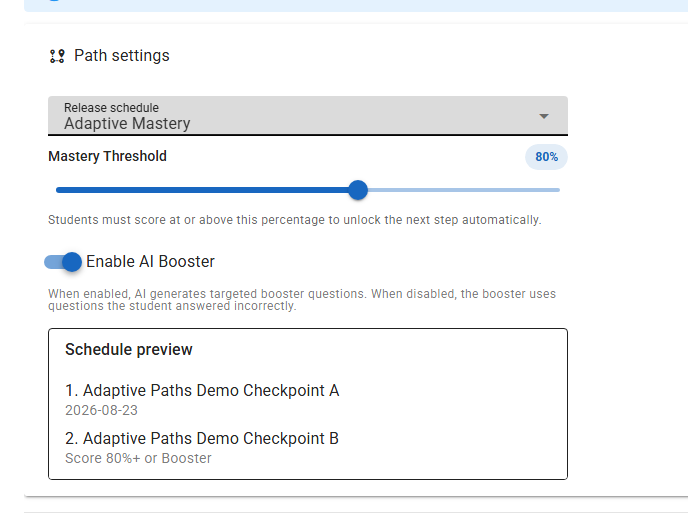
When assigning a path, the teacher chooses a mastery threshold between 50 and 100 percent. A threshold is most useful when the activity actually samples the objective well. Eighty percent on a thoughtful ten-question check may be meaningful; eighty percent on two nearly identical questions is fragile evidence. Start with the consequence you are willing to attach to the score, then choose the threshold—not the other way around.
What happens after a student finishes a step
Gamena calculates mastery from the first completed attempt. If the score meets the threshold, the next path step opens. If it does not, the next step stays locked and a booster appears. That makes the rule predictable: finishing is still recognized, but completion alone is not treated as proof that the learner is ready for dependent work. A replay remains available for practice, but it does not rewrite the first-attempt evidence used for routing.
AI changes the questions, not the policy
With Enable AI Booster turned on, Gamena prepares new questions targeted at the items the learner answered incorrectly. The questions are prepared in the background, so a student may briefly see that the booster is being made ready. If generation cannot produce a usable set, the system falls back to copied missed questions instead of leaving the learner stranded.
- The teacher sets the threshold.
- The learner’s first completed attempt supplies the mastery score.
- AI may draft the booster content, but it does not decide the standard.
- A fallback keeps the route available if AI generation fails.
The non-AI route is still a real booster
Turning AI off does not turn support off. Gamena builds a booster from the original questions the student missed. This is a good fit when a school prefers not to generate new material, when the source questions are already carefully designed, or when the teacher wants the closest possible correction loop. The trade-off is that the learner sees familiar questions rather than a fresh test of transfer.
Design the checkpoint before the booster
The booster can only be as useful as the step that triggers it. Keep scored questions aligned to one clear objective, check accepted answers and translations, and avoid making one ambiguous item determine access to the rest of a long path. If several objectives share one activity, split the checkpoint or lower the consequence of the threshold.
A practical first rollout
Start with one short path where later work genuinely depends on the earlier skill. Use a moderate threshold, review the missed-question patterns, and play the booster as a student before assigning widely. After the first class, ask a simple question: did the booster address a real gap, or did it mostly expose a weak question? That distinction is where teacher judgment remains essential.
- Choose a path with a real prerequisite relationship.
- Use enough questions to make the threshold meaningful.
- Preview both the mastery and booster experiences.
- Review why students entered boosters.
- Revise the source activity when the evidence is noisy.